


Is the New Hyundai Santa Fe a Reliable SUV?
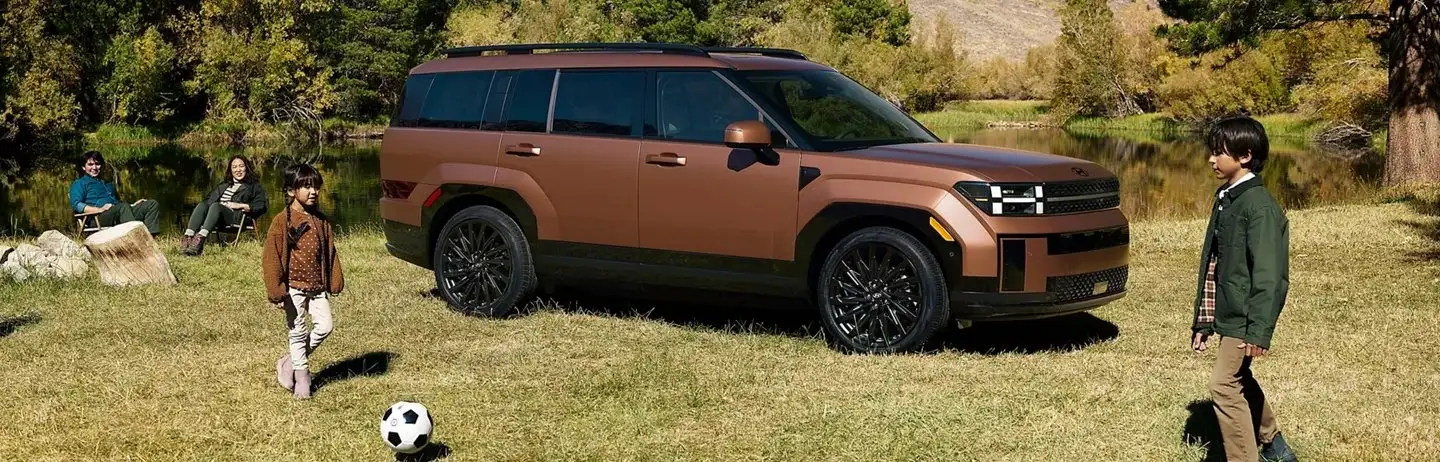
Yes, the new Hyundai Santa Fe can be a good and reliable SUV for shoppers whose priorities match its three-row seating, flexible cargo space, available HTRAC All Wheel Drive, and choice of gas or hybrid power. The most useful answer comes from looking at several factors together: current owner-based ratings, safety testing, warranty coverage, expected longevity, resale value, maintenance needs, and how well the SUV fits everyday driving.
Current Hyundai Santa Fe at a Glance
The current U.S. Hyundai Santa Fe lineup includes gas and hybrid models with three-row seating and available AWD. Confirm the model year, trim, drivetrain, and equipment shown on the individual vehicle before making a final decision.
- Gas trims: SE, SEL, XRT, Limited, and Calligraphy
- Hybrid trims: SE, SEL, Limited, and Calligraphy
- Gas powertrain: Turbocharged 2.5-liter four-cylinder engine producing 277 horsepower and 311 pound-feet of torque
- Gas transmission: Eight-speed automatic
- Hybrid powertrain: Turbocharged 1.6-liter four-cylinder engine and electric motor producing 231 combined horsepower
- Hybrid transmission: Six-speed automatic
- Drivetrains: Front-wheel drive or available HTRAC AWD; AWD is standard on the gas XRT
- Seating: Up to seven passengers, depending on the trim and second-row configuration
- Maximum cargo volume: Up to 79.6 cubic feet behind the front seats
What We Know About Hyundai Santa Fe Reliability
The new Hyundai Santa Fe is a strong three-row SUV candidate for drivers who value passenger flexibility, useful cargo configurations, modern technology, and a choice between gas and hybrid powertrains. Its squared-off shape also helps create a practical cabin without requiring shoppers to move into a substantially larger SUV.
Current third-party evidence supports a positive reliability assessment. J.D. Power gives the current Santa Fe a Quality & Reliability score of 81 out of 100, which it categorizes as “Great.” Its Driving Experience score is 88 out of 100. These scores reflect reported owner experiences and provide useful early evidence, but they do not guarantee that every vehicle will have the same ownership history.
Safety performance also supports the Santa Fe’s family-SUV credentials. The 2026 Hyundai Santa Fe earned an IIHS Top Safety Pick+ award. The Insurance Institute for Highway Safety gave it Good ratings in the small-overlap front, updated moderate-overlap front, and updated side evaluations.
The Santa Fe may be a good fit when your priorities include:
- Three rows for children, relatives, friends, or occasional additional passengers
- Flexible cargo space for school bags, groceries, sports equipment, or weekend gear
- A choice between conventional gas and hybrid power
- Available AWD for drivers who prefer four-wheel propulsion
- Useful towing capacity for an appropriately equipped small trailer
- A manageable footprint for errands around Davisville and workday travel toward Quonset
No SUV is right for every household. Shoppers who regularly need an adult-friendly third row with substantial luggage room behind it may prefer a larger vehicle. Drivers who rarely carry more than five people may find that a two-row SUV meets their needs with less unused space.
What Changed with the Santa Fe Transmission?
Shoppers researching Hyundai Santa Fe reliability may encounter discussions about the eight-speed dual-clutch transmission used in 2024 and 2025 gas models. Hyundai changed the gas Santa Fe to an eight-speed automatic transmission for the 2026 model year.
The change applies to gas models with the turbocharged 2.5-liter engine. The Santa Fe Hybrid uses a different powertrain and continues with a six-speed automatic transmission. This model-year distinction is important when comparing specifications, reviews, owner discussions, or used Santa Fe vehicles.
How Long Do Hyundai Santa Fe Models Last?
There is no mileage that every Hyundai Santa Fe is guaranteed to reach. A properly maintained Santa Fe may provide many years of service, but actual longevity depends on the model year, maintenance history, driving conditions, accident history, repairs, and how quickly emerging concerns are addressed.
iSeeCars currently estimates that the Hyundai Santa Fe has an average model-level lifespan of approximately 136,000 miles, or about 9.7 years. Its analysis estimates that roughly 10% of Santa Fe vehicles reach at least 200,000 miles.
Those figures are based on Santa Fe vehicles from multiple model years and generations. They should not be treated as a prediction for an individual SUV or as a long-term reliability verdict for the newest generation.
The likelihood of a Santa Fe providing long service is generally supported by:
- Following the maintenance schedule for the exact model year and powertrain
- Using the specified fluids, filters, replacement parts, and service procedures
- Checking tire condition and fluid levels between scheduled visits
- Responding promptly to warning lights, leaks, unusual noises, or changes in operation
- Keeping complete maintenance and repair records
- Repairing body damage and protecting exposed metal from corrosion
Hyundai provides separate normal-use and severe-use maintenance schedules. Repeated short trips in freezing temperatures, stop-and-go traffic, towing, very cold weather, and driving on salt-spread roads may require more frequent service. That can be relevant for a routine built around short trips near Wickford Junction or winter travel along Route 102.
How Well Does the Hyundai Santa Fe Hold Its Value?
The Hyundai Santa Fe has competitive estimated resale value for a midsize SUV. iSeeCars estimates that a new Santa Fe retains approximately 54.4% of its original value after five years. Its midsize-SUV category average retains approximately 53.7% over the same period.
J.D. Power also gives the current Santa Fe a Resale score of 88 out of 100, categorized as “Great.” That score forecasts expected depreciation over the following three years rather than guaranteeing a specific future selling or trade-in price.
Actual Santa Fe resale value depends on several factors:
- Model year, trim, powertrain, and drivetrain
- Mileage and overall condition
- Maintenance and repair records
- Accident and vehicle-history information
- Local used-vehicle demand
- Color and installed equipment
- Market conditions when the vehicle is sold or traded
The newest Santa Fe generation arrived for the 2024 model year, so it does not yet have five years of its own real-world resale history. Five-year projections draw partly from earlier Santa Fe generations and broader market data.
Should You Choose the Gas or Hybrid Hyundai Santa Fe?
Choose between the gas and hybrid Santa Fe according to how you drive, how much you plan to tow, and how highly you prioritize fuel economy. There is not enough long-term evidence to declare either current powertrain universally more reliable than the other.
Gas Hyundai Santa Fe
The gas Santa Fe uses a turbocharged 2.5-liter four-cylinder engine producing 277 horsepower and 311 pound-feet of torque. It is paired with an eight-speed automatic transmission and offered with front-wheel drive or HTRAC AWD.
The gas model provides the highest towing capacity in the current lineup. Most gas trims can tow up to 3,500 pounds with trailer brakes when properly equipped, while the AWD XRT can tow up to 4,500 pounds with trailer brakes when properly equipped.
Hyundai Santa Fe Hybrid
The Santa Fe Hybrid combines a turbocharged 1.6-liter engine with an electric motor for 231 combined horsepower. It uses a six-speed automatic transmission and is available with front-wheel drive or HTRAC AWD.
The hybrid battery recharges through the engine and regenerative braking, so the Santa Fe Hybrid does not need to be plugged in. It provides higher EPA-estimated fuel economy than the gas model but has a lower maximum towing rating of 2,000 pounds with trailer brakes when properly equipped.
- Consider the gas Santa Fe when acceleration, current maximum towing capacity, or the XRT configuration is a priority.
- Consider the Santa Fe Hybrid when higher EPA-estimated fuel economy and reduced fuel use are more important.
- Compare both powertrains when ride quality, cabin noise, trim equipment, and overall driving feel are central to the decision.
What Gas Mileage Does the Hyundai Santa Fe Get?
EPA-estimated fuel economy varies by powertrain and drivetrain:
- Gas Santa Fe with front-wheel drive: 20 city, 29 highway, and 24 combined mpg
- Gas Santa Fe with HTRAC AWD: 20 city, 28 highway, and 23 combined mpg
- Gas Santa Fe XRT AWD: 19 city, 25 highway, and 21 combined mpg
- Santa Fe Hybrid with front-wheel drive: 37 city, 36 highway, and 36 combined mpg
- Santa Fe Hybrid with HTRAC AWD: 35 city, 34 highway, and 34 combined mpg
EPA estimates are intended for comparison. Actual mileage varies with temperature, trip length, traffic, speed, cargo, climate-control use, vehicle condition, equipment, and driving habits. Short winter trips may produce different results than longer drives after the powertrain has reached its normal operating temperature.
What Warranty Comes with a New Hyundai Santa Fe?
Hyundai’s current new-vehicle warranty package includes several separate forms of coverage:
- New Vehicle Limited Warranty: Five years or 60,000 miles
- Powertrain Limited Warranty: Ten years or 100,000 miles for the original owner
- 24-Hour Roadside Assistance: Five years with unlimited mileage
- Anti-Perforation Warranty: Seven years with unlimited mileage
The Santa Fe Hybrid also includes a 10-year or 100,000-mile Hybrid/Electric Battery and Hybrid System Components Warranty. Hyundai lists coverage for specified components including the hybrid battery, hybrid starter/generator, hybrid power control unit, and automatic transmission with traction motor.
Warranty coverage is valuable ownership protection, but it is not a guarantee that a vehicle will never require maintenance or repairs. Coverage terms, exclusions, ownership requirements, maintenance obligations, and transferability are defined in Hyundai’s warranty documents.
Does the Hyundai Santa Fe Have Three Rows?
Yes. The current Hyundai Santa Fe is a three-row SUV with seating for up to seven passengers. Seating capacity varies because some trims use a second-row bench while others include or offer second-row captain’s chairs. Current cargo measurements are:
- Behind the third row: 14.6 cubic feet
- Behind the second row: 40.5 cubic feet
- Behind the front seats: Up to 79.6 cubic feet
Passenger and cargo needs should be considered together. The Santa Fe provides substantial maximum cargo room with the rear seats folded, but available cargo space is more limited when all three seating rows are occupied.
Does the Hyundai Santa Fe Offer AWD?
Yes. HTRAC AWD is available on the current gas and hybrid Santa Fe lineups. The gas Santa Fe XRT includes AWD as standard equipment, while the other current gas trims offer it as an option. AWD is available on every current Santa Fe Hybrid trim.
AWD can help distribute propulsion between the front and rear wheels when traction is limited. It does not guarantee grip, shorten braking distances, or replace tires appropriate for the conditions. Drivers still need to adjust speed, steering, and following distance during snow, ice, or heavy rain.
How Much Can the Hyundai Santa Fe Tow?
Current Hyundai Santa Fe towing capacity depends on the powertrain and configuration:
- Gas Santa Fe SE, SEL, Limited, and Calligraphy: Up to 3,500 pounds with trailer brakes when properly equipped
- Gas Santa Fe XRT: Up to 4,500 pounds with trailer brakes when properly equipped
- Santa Fe Hybrid: Up to 2,000 pounds with trailer brakes when properly equipped
Towing requires the correct vehicle configuration, hitch components, trailer equipment, loading, and operating procedures. Review the owner’s manual and the specifications for the individual vehicle before attaching a trailer.
Compare the New Hyundai Santa Fe in North Kingstown
The new Hyundai Santa Fe can be a good and reliable SUV for drivers who value three-row flexibility, useful cargo space, available AWD, competitive resale estimates, and a choice between gas and hybrid power. Early owner-based scores and current safety results are encouraging, while the newest generation’s complete long-term reliability record will continue to develop over time.
Explore our new Hyundai Santa Fe inventory, compare available models in our Santa Fe Hybrid inventory, or review additional details in our Hyundai Santa Fe research guide. Visit Nucar Hyundai of North Kingstown to find the configuration that fits your routine and discover why Everyone Loves A Nucar!
References
- Hyundai Santa Fe Overview
- Hyundai Santa Fe Specifications
- Hyundai Santa Fe Hybrid Overview
- Hyundai Santa Fe Hybrid Specifications
- Hyundai 2026 Model Year Changes
- Hyundai Warranty Coverage
- Hyundai Maintenance Under Severe Usage Conditions
- IIHS 2026 Hyundai Santa Fe Safety Ratings
- J.D. Power 2026 Hyundai Santa Fe Ratings
- iSeeCars Hyundai Santa Fe Reliability and Lifespan
- iSeeCars Hyundai Santa Fe Resale Value and Depreciation
0 comment(s) so far on Is the New Hyundai Santa Fe a Reliable SUV?